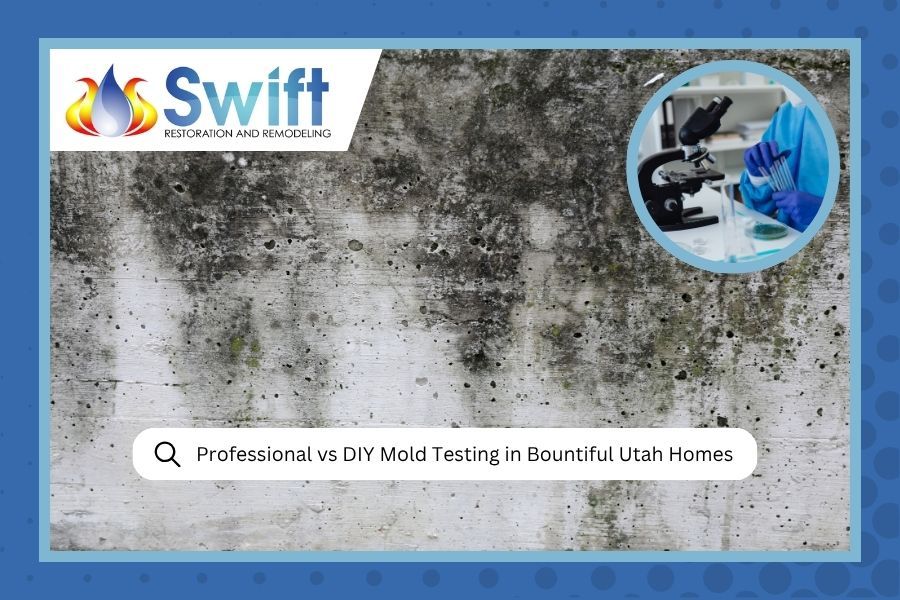
Professional vs DIY Mold Testing in Bountiful Utah Homes
Updated On: June 16, 2026
Author: Darin Jenks
Mold is one of those problems that sounds manageable until you're holding a $15 test kit wondering if the patch near your crawl space actually needs expert attention. For homeowners in Bountiful, Utah, that question carries real weight. Our team at Swift Restoration and Remodeling has inspected hundreds of Northern Utah homes, and we've seen how often the wrong approach to mold testing and inspection delays real solutions. Here's what each method actually does, where each falls short, and when professional testing saves you far more than it costs.
Not Sure What You're Dealing With?
Mold hides behind walls, under flooring, and in crawl spaces. If something smells off or you've had recent water damage, getting an expert opinion before it spreads is worth it.
Contact Our TeamWhy Bountiful Homes Are Especially Vulnerable to Mold
Bountiful sits right along the Wasatch Front, which means it gets the full Utah weather experience: cold wet winters, significant snowpack, and spring runoff that pushes moisture into foundations and crawl spaces. Mold doesn't just show up after a visible flood here. It grows quietly, behind drywall and under insulation, in spaces nobody checks until there's a smell or a health symptom.
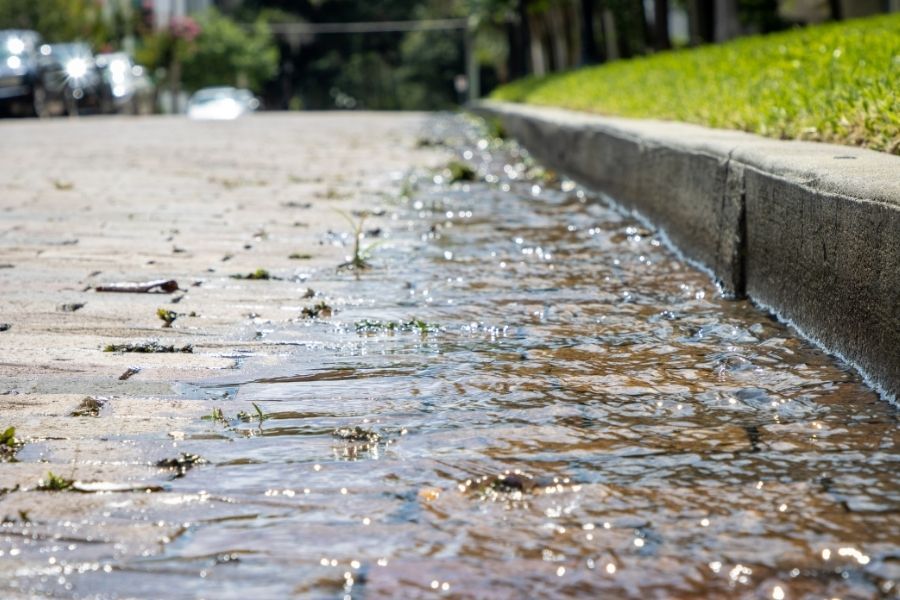
Utah's climate swings between dry summers and wet shoulder seasons. That variation causes wood framing and drywall to expand and contract, cracking seals and letting moisture work its way in. Homes in lower-lying parts of Bountiful, or those with older drainage systems, are especially susceptible to moisture intrusion from Wasatch Mountain snowmelt. According to the EPA's guide on mold and moisture, controlling indoor moisture is the most effective prevention strategy, and in a climate like ours, that requires real vigilance.
What DIY Mold Tests Actually Do (and Don't Do)
DIY mold test kits cost $15 to $50 at most hardware stores. Most use petri dish cultures or tape lift samples. You expose the dish, wait a few days, and see if colonies grow. Some let you mail the sample to a lab for species ID at added cost.
Here's the problem: mold spores exist in virtually every indoor and outdoor environment. A positive result basically confirms mold exists somewhere in the air, which you already knew. It doesn't tell you what type you have, what concentration is present, where it's coming from, or whether your indoor levels are elevated compared to the outdoor baseline.
The Four Gaps That Matter Most
- No source identification: A positive result tells you mold is present. It doesn't tell you there's an active colony behind the bathroom wall that's been growing for months.
- No air quality baseline: Without comparing indoor and outdoor spore counts, you can't know if indoor levels are actually elevated.
- Limited species ID: Some mold types require different remediation approaches. Generic kits rarely distinguish between them.
- No hidden area coverage: DIY tests only sample what you can access. The mold causing your symptoms may be inside a wall cavity, under the subfloor, or in your HVAC system.
That's not to say DIY kits are worthless. For a small visible spot on tile grout, a kit can confirm whether it's mold before you clean it. But for musty smells, past water damage, or health symptoms correlating with time at home, a DIY test leaves you just informed enough to feel uncertain. Our post on how to prevent mold after water damage covers the growth timeline and warning signs to watch for after any moisture event.
What Most Homeowners Don't Know About Mold
24-48 hrs
Mold can begin growing after moisture exposure
>70%
Of mold growth occurs in areas you can't see
$15-$50
DIY kit cost, with limited actionable results
What Professional Mold Testing Looks Like
Professional mold testing goes well beyond confirming that mold exists. A trained inspector uses calibrated equipment to assess scope, identify moisture sources, and give you a clear picture before any remediation work begins.
Air Quality Sampling
Industrial air sampling pulls a measured volume of air through a cassette that captures spores. Samples go to a certified lab and come back with spore counts and species breakdowns. Inspectors also take an outdoor baseline sample the same day, so indoor levels can be compared to what's naturally present outside. That comparison is what tells you whether you have an actual elevated indoor problem.
Moisture Mapping
Thermal imaging cameras and moisture meters identify elevated moisture behind walls, under flooring, and inside ceiling cavities without destructive work. Finding the moisture source is what prevents mold from returning after remediation. At Swift Restoration and Remodeling, we pair moisture mapping with visual inspection on every mold job we handle in Bountiful, Davis County, and Weber County.
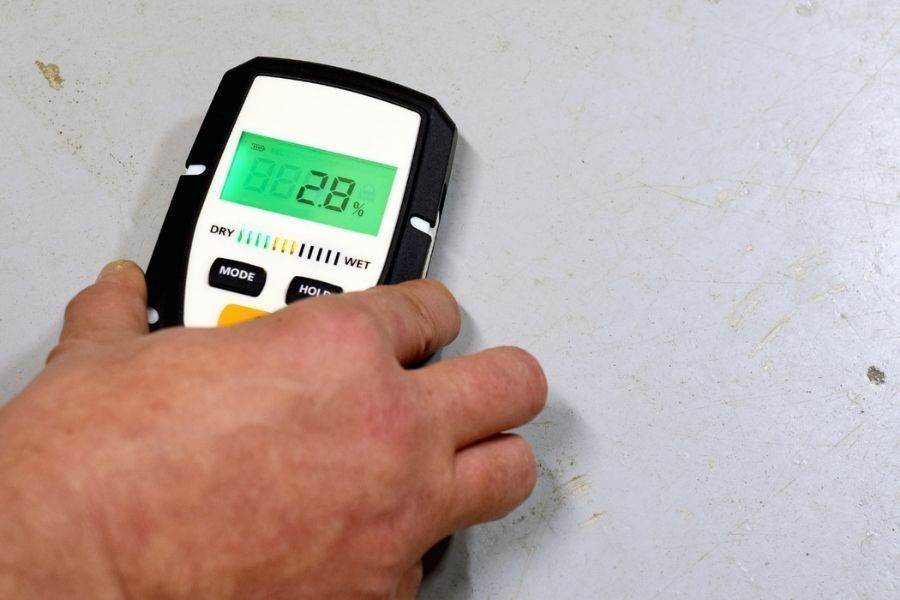
When remediation is needed, professional testing results shape the remediation protocol. The IICRC S520 standard for mold remediation requires that work scope be based on documented testing, not guesswork. That's one reason professional testing pays for itself when a real problem is present.
Pro vs. DIY Mold Testing: Side-by-Side
| Feature | DIY Mold Test | Professional Inspection |
|---|---|---|
| Confirms mold presence | Yes (surface/air only) | Yes, with species ID and spore counts |
| Identifies mold type | Limited | Yes, certified lab analysis |
| Detects hidden mold | No | Yes, thermal + moisture mapping |
| Outdoor baseline comparison | No | Yes, standard practice |
| Finds moisture source | No | Yes, moisture meters + inspection |
| Actionable remediation plan | No | Yes, documented findings |
| Insurance documentation | Not typically accepted | Accepted by most carriers |
When You Really Need a Professional
Some situations are clear calls. If your Bountiful home had water damage that wasn't fully dried within 48-72 hours, professional testing is worth it. Same goes for a musty smell you can't locate, visible mold larger than one square foot, or health symptoms in household members that improve when they're away from home.
Here are the situations where professional testing should replace the DIY approach:
- After any water damage event, including appliance leaks, roof leaks, and basement flooding from snowmelt or spring runoff
- When buying or selling a home in Bountiful or Davis County, especially in older construction
- Recurring musty smells that return even after visible mold has been cleaned
- Before or after HVAC work, since mold in ductwork distributes spores throughout the entire home
- When a DIY test came back positive and you need to understand scope before remediating
The goal of mold testing isn't just confirming that mold is present. It's understanding your situation well enough to fix it once and fix it right. If you've had water damage and want to know what might be left behind, our post on hiring a mold removal company after water damage covers the right questions to ask. For local patterns specific to Bountiful, check out our Bountiful service area page.
Think You Might Have a Mold Problem?
Our IICRC-certified team serves Bountiful, Davis County, Weber County, and throughout Northern Utah. We give you a real picture of what's going on, not a guesswork-based one.
Get Help TodayFrequently Asked Questions
Can a DIY mold test identify black mold in a Bountiful home?
Most consumer DIY kits can't reliably identify Stachybotrys chartarum or distinguish it from other dark-colored molds. Accurate species identification requires certified lab analysis, which is standard in professional inspections but not included in basic retail kits. If you're concerned about black mold, a professional inspection is the only reliable path.
How long does professional mold testing take in Bountiful?
The on-site inspection typically takes one to three hours depending on home size and number of areas tested. Samples go to a certified laboratory, with results back in three to five business days. Your inspector will walk you through findings and outline next steps if remediation is needed.
Will Utah homeowners insurance cover professional mold testing?
Coverage depends on your specific policy and what caused the mold. Most standard homeowners policies in Utah cover mold remediation resulting from a covered event like a burst pipe or appliance leak. Mold from long-term moisture or deferred maintenance is typically excluded. Professional reports are generally required by carriers to document scope before approving a claim.
Are Bountiful homes at higher mold risk because of the Wasatch Front climate?
Yes, Bountiful and Davis County homes face specific climate-related risks. Proximity to the Wasatch Mountains means significant snowmelt and spring runoff that can push moisture into foundations. Seasonal temperature swings cause building materials to expand and contract, which can compromise seals over time. Older homes with crawl spaces or limited drainage are especially vulnerable.